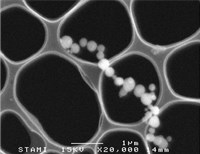
In the present atlas you will find information on particles in aerosols or settled dust from different work environments. The data are presented as electron micrograph images and X-ray spectra. The images show the morphology, surface structure and size of the particles while the X-ray spectra provide information on their chemical composition. The brief text gives information on the identity of the particles, points to unique characteristics and describes possible sources. Norwegian keywords are included in the text.
Why a Particle Atlas?
Characterisation and identification of the particles in aerosols are important for several reasons. Particle size is a major indicator of respiratory tract deposition. Data on chemical composition and morphology make it possible to identify the particles, which is important for evaluation of human health risk. Particle identification may also indicate contamination sources. This is useful for preventive actions.
Characterisation, identification and quantification of particles are often time consuming. For this reason our electron microscopy laboratory (EM-lab) has been equipped with an automated analytical system. This is a Jeol JSM 6400 scanning electron microscope combined with a ThermoNoran Vantage DSI X-ray microanalysis system (SEM/EDS). With this advanced analytical equipment and skilled people with many years of experience on particle identification from different work environments, we have built up a large amount of knowledge on aerosols. This information is organised and stored in a database. We would like to share our knowledge with customers and collaborators through the present Particle Atlas. Here images, x-ray spectra and facts about the different particle types are published and this information is accessible for external users.
The National Institute of Occupational Health (NIOH) has the copyright of this material, but you can download the images for your own purpose as long as our institute is cited. High-resolution images are available by contacting us.