Concrete consists of aggregates (crushed rock, gravel or sand) cement and water. The aggregates make up typically 70 – 80 percent of the concrete by weight. The cement is produced primarily from limestone (calcite), together with smaller amounts of gypsum, bauxite, quartz and iron slag. This mix is burned in a kiln at 1500 o C to give hydraulically active calcium silicate minerals. Cement functions as a glue when the constituents are mixed with water. Further additives up to a few percent give the final product improved qualities. Some of these additives are fly ash and micro silica (pozzolans) and have cementitious properties in reaction with alkalies.
The particles in the SEM micrograph originate from concrete dust. The X-ray spectrum acquired from Particle no 1(spectrum 1) shows high concentrations of Ca, S and O and can be identified as gypsum. This material is added to cement to control the drying and hardening process during casting of the concrete. Most of the volume and weight of concrete consist of sand, gravel or crushed stone. Particle no. 2 (spectrum 2) is a mineral grain, probably biotite, from this component. Particle no. 3 (spectrum 3) originates from the Portland cement component with high concentrations of Ca and O.
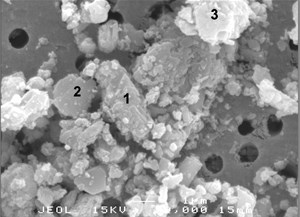
Concrete dust particles showing different morphology
and chemical composition (see below).
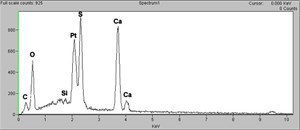
X-ray spectrum from particle 1
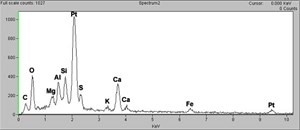
X-ray spectrum from particle 2
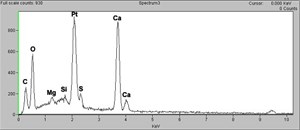
X-ray spectrum from particle 3
Norwegian key terms: betongstøv, sement