Asbestos is strictly speaking not a scientific designation, but is a generic name of six fibrous varieties of different minerals. It has been used commonly in many building materials as well as in industrial applications. In the Western world its use is banned due to its carcinogenic properties.
Application
The unique technical properties have made asbestos very useful as thermal or electrical insulation. It is strong yet flexible and therefore found its application in cements and coatings. It is also non-combustible and corrosion resistant. Due to these qualities, its easy winning and low costs, asbestos has been commercially utilized for about 130 years. One study estimated that about 3000 different commercial products contained asbestos.
Exposure and health
The carcinogenic properties of asbestos fibres have been gradually realized and massive documentation of the serious health hazards of asbestos fibres was established from about 1930 and onward. In the western world its use has therefore been banned since the nineteen eighties due to its hazardous biological effects. Still we have to live with this potentially harmful material because of earlier use. In buildings raised before 1980 the use of ACM as roofing, flooring and lining, both internal and external, was very frequent. Intact and well-kept ACM does not represent any harm. Any mechanical processing of ACM will inevitably liberate fibres. Lack of awareness for these conditions still causes unnecessary exposure of asbestos when demolition or remodelling of buildings is carried out.
Analysis – air samples
Contrary to other contaminants in the working atmosphere that are measured in “parts-per” or mass units, asbestos concentrations are measured as number of fibres/volume of air. The analysis is done by counting fibres collected on a filter after a known volume of air has been sucked through it. The counting is done by phase-contrast optical microscopy. A countable fibre is > 5 µm long, < 3 µm wide and with a length: width ratio > 3:1. This protocol also applies to the determination of other fibre types, e.g. man-made vitreous fibres in the working atmosphere. But the simple phase-contrast optical microscopy technique alone cannot distinguish between different fibre types. To perform this task one has to use more advanced instrumentation like analytical scanning or transmission electron microscopy.
Analysis – bulk samples
Demolition or remodelling of old buildings might release fibres to the indoor air and contaminate the surroundings if ACM are involved. Materials in question should therefore be checked in advance to reveal this. Reliable identification of fibre types in bulk samples can be done by different methods. The recommended methods are: The polarized light microscopy method (PLM), analytical scanning or transmission electron microscopy (ASEM/ATEM) and finally x-ray diffraction (XRD).
The images below show typical features and distinguishing characters of some asbestos types.

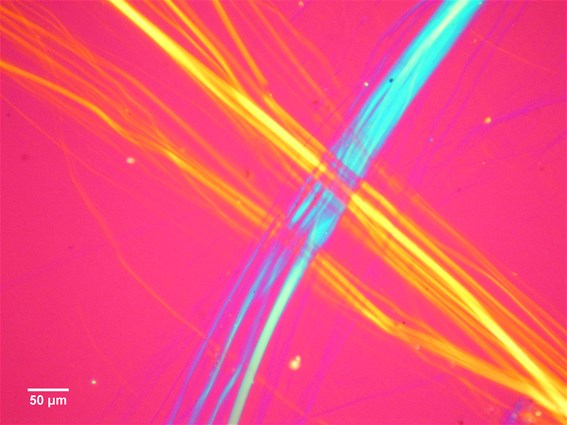
Image 1 Test for sign of elongation on chrysotile fibres using crossed polars and first order red compensator (gypsum plate) aligned with the slow direction in the NE-SW direction. This optical manipulation causes striking interference colour effects. Chrysotile and all the other asbestos fibre varieties except crocidolite, have a positive sign of elongation. They will show yellow fibres oriented in the NW-SE direction, while they are blue in the NE-SW.
.aspx)
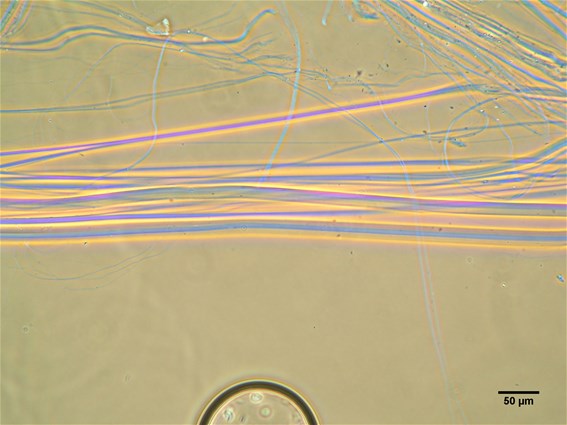
Image 2 Alternative test for sign of elongation. Chrysotile asbestos fibres embedded in oil with a refractive index (RI) of 1. 550 which matches the RI of chrysotile itself, imaged in phase contrast light microscopy and plane polarized light. The vibration plane of the light is in the E-W direction. The fibres oriented parallel to the vibration plane are dark blue with yellow halo.
.aspx)
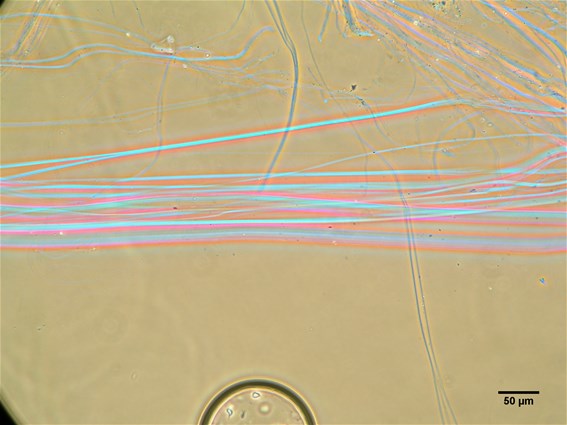
Image 3 Same fibres as in Image 2, but with the polarizing filter rotated 90 ? to give a vibration plane perpendicular to the fibre length. The fibres which are oriented perpendicular to the vibration plane show pale blue colour with red halo.
.aspx)
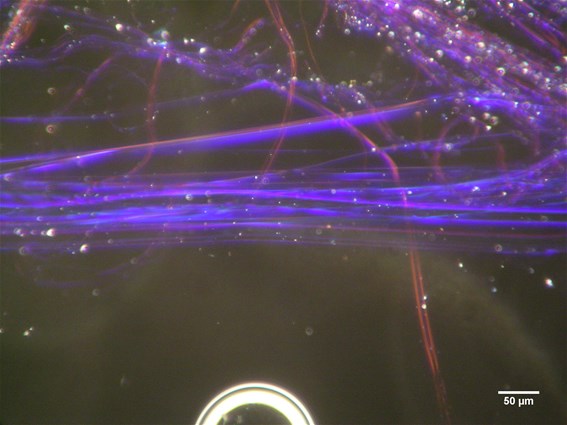
Image 4 Central stop dispersion staining colours. This technique requires the use of the McCrone Dispersion Staining Objective. Similar results can be obtained with polarized light, a phase contrast objective and dark field illumination as imaged in this picture. The image shows chrysotile fibres (same fibres as in Image 2) embedded in Cargille oil with refractive index (RI) = 1.550 and using one polarizing filter perpendicular to the fibre length. This setup gives blue chrysotile fibres.
.aspx)
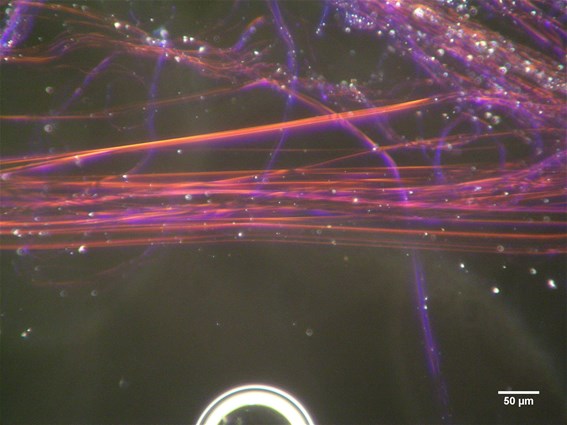
Image 5 The same chrysotile fibre bundles as in Image 4, but with the polarizing filter paralell with the fiber length. This setup gives purple chrysotile fibres.
.aspx)
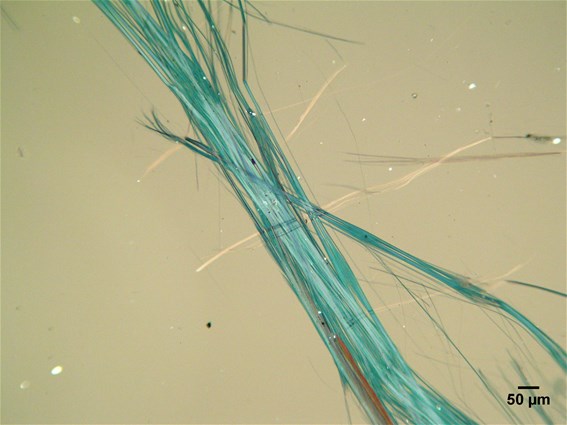
Image 6 and 7 (below) show the pleochroic nature of crocidolite asbestos fibres. Pleochroism is defined as a change in fibre colour with orientation relative to the vibration plane of the polarized light. The fibres are imaged with the polarizer rotated a small angle off the crossed polar position.
.aspx)
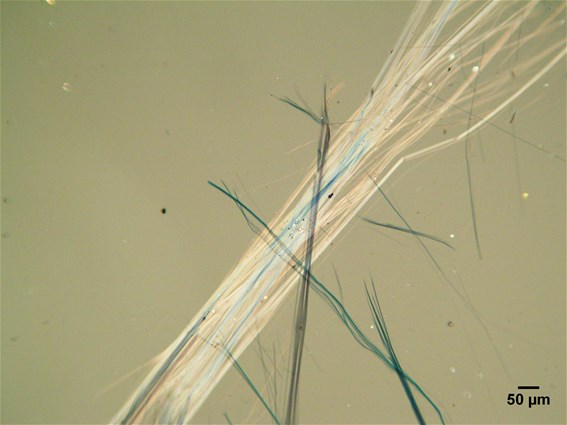
Image 7 The same crocidolite fibre bundle as in image 6, rotated about 90 °.
.aspx)
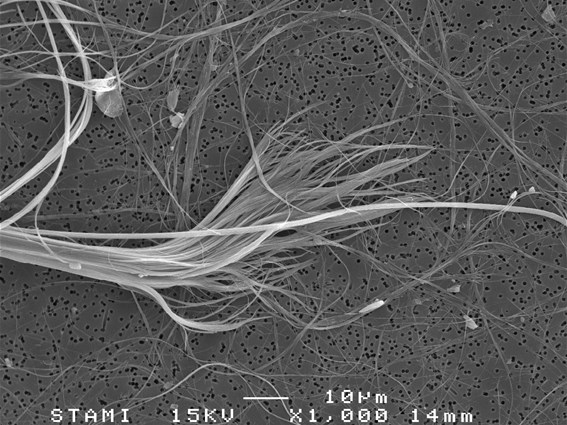
Image 8 Fibres and large fibre bundle (with splayed end) of chrysotile imaged in the scanning electron microscope. The wavy appearance of the fibres are typical of chrysotile asbestos.
.aspx)
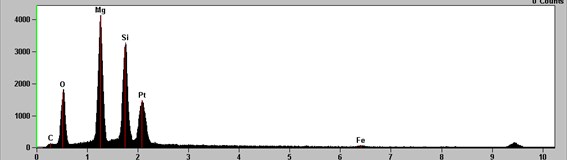
Image 9 X-ray spectrum of the chrysotile fibres depicted in image 7 obtained at an accelerating voltage of 20 keV on the SEM. Chrysotile show high content of Si and Mg, but only traces of Fe.
.aspx)
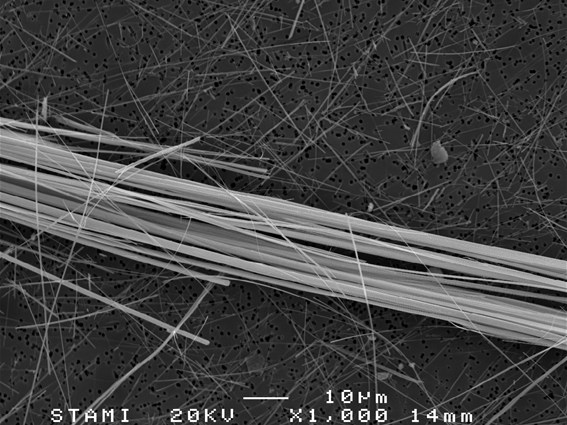
Image 10 Crocidolite asbestos viewed in the SEM. Straight fibres and fibre bundles are typical of crocidolite which is considered to be the most hazardous asbestos fiber.
.aspx)
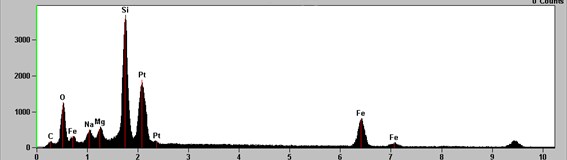
Image 11 X-ray spectrum of crocidolite fibres depicted in image 9 obtained at an accelerating voltage of 20 keV on the SEM. The spectrum shows Na, Mg, Si and Fe. The presence of Na is typical of crocidolite.
.aspx)
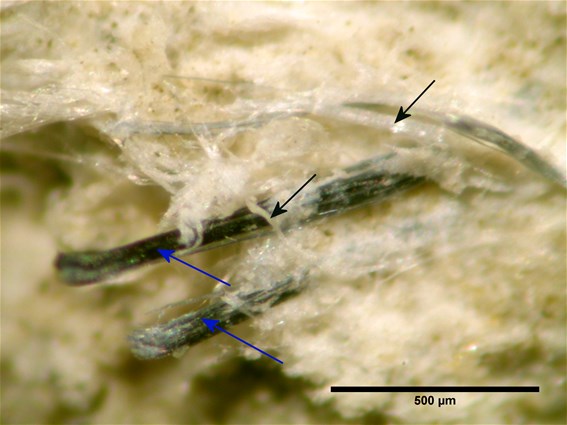
Image 12 Light microscope image from sample of asbestos cement roof showing crocidolite (blue arrows) and chrysotile (black arrows) fibre bundles.
.aspx)
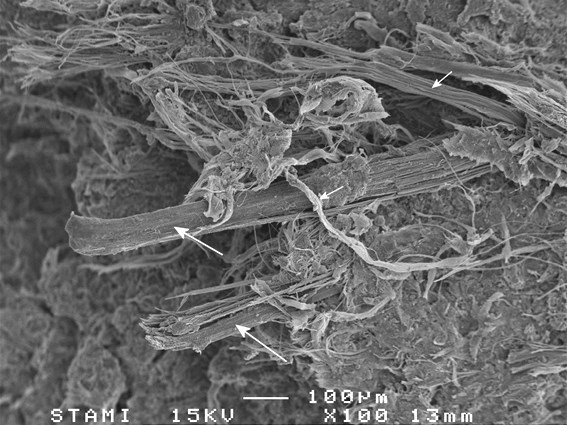
Image 13 Same sample as in Image 11, but viewed in SEM. Long arrows indicate crocidolite, short arrows chrysotile fibres.
Norwegian keywords: Asbestholdige materialer, hvitasbest, blåasbest, analysemetoder, scanning elektron mikroskopi, polarisasjon lysmikroskopi, fasekontrast lysmikroskopi